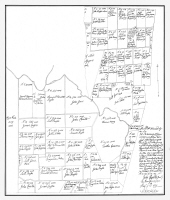
Historic 1719 map Plat of Mashmoquet. Thanks to Kay Koslan for locating this record.
Ontario was known as: "Upper Canada" from
December
26, 1791, to February 10, 1841;
"Canada West" from February 10, 1841, to July
1, 1867; and
"Ontario" after July 1, 1867.
It is surmised that Nathaniel
Abner Abbey Sr. (age 22), and his wife Mary "Polly" (Winter) Abbey (age 21), and
their two children,
Rosana "Rosa" Abbey (about age 2), and Isaac Phineas Abbey (about age 1),
came to Haldimand Twp., Northumberland Co., Upper Canada, in 1797. They were some of the pioneering settlers of Durham Co., Upper
Canada. The Abbey
ancestry can be connected through their father Isaac Abbey Jr. all the way back to John Abbey
Sr., born about 1587 in West Halton, Lincolnshire, England. His son, John Abbey
Jr. of Norwich, Norfolk Co., England, emigrated to the United States about
1635 and married Mary Unknown in 1635 at Wenham, Essex Co., MA.
It is also surmised that Nathaniel
Abner Abbey Sr.'s brother, Isaac Abbey III (age 31), and his wife Anne (King) Abbey
(age 30), his unmarried sister, Dorcas
Potts Abbey (age 17), and their infant nephew,
Clement Edmond Neff Sr. (age 5),
came to Haldimand Twp., Northumberland Co., Upper Canada, about 1802.
Molly Shannon's website:
https://www.ancestry.com/family-tree/person/tree/58047097/person/290247563407/facts
Wendy Mulligan's The TreeDR website:
https://www.ancestry.com/family-tree/person/tree/89316435/person/430025106130/facts
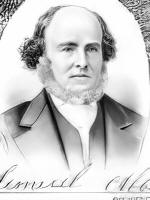
This drawing
is of Samuel Abbey, the son of
Ebenezer Abbey Sr. and Mary Elizabeth (Allen) Abbey.
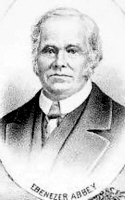
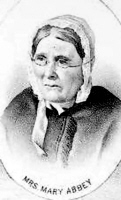
These
are drawings of Eli Ebenezer Abbey, and and his wife, Mary Ann (Blanchard)
Abbey. Eli Ebenezer Abbey is the grandson of
Ebenezer Abbey Sr. and Mary Elizabeth (Allen) Abbey, and the son of Samuel
Abbey and Temperance (Lincoln) Abbey.
The Canada Society Church; The Second
Congregational Church, Hampton, Windham Co., CT
The Congregational Church in Hampton,
CT, was originally the Second Congregational Church in Windham Village, CT, also
known as the Canada Society Church. Organized on June 5, 1723, it took its name
from Canada Parish, comprising all of the village of Windham, which was named
after David Canada, who built the first house in this area and kept the first
tavern. Windham village later become the town of Hampton in 1786, and this
church became the Congregational Church in Hampton. The Reverend Samuel Moseley,
a close friend and supporter of Eleazar Wheelock's Indian School, was the pastor
there from 1734 until his death in 1791.
Ebenezer Abbey Sr.
was born July 31, 1683, in Salem Village, Essex Co.,
Massachusetts Bay Colony.
Mary Elizabeth Allen was born June 10,
1688, in Windham, Windham Co., Colony of Connecticut.
Thus it was in 1692, only a few years
after the first Anglo-American colonists had moved into Joshua’s Tract, that the
Connecticut General Court (the colonial assembly) chartered the Town of Windham.
Originally, the new town encompassed all of Joshua’s Tract, along with a smaller
tract called Mamasqueeg that Joshua had left to his own family. The new town was
bounded by Norwich on the south, the Nipmuck Path on the east, a wetland known
as Appaquage at the northeast corner, a line running due west until from
Appaquage to the Willimantic River on the north, and the Willimantic and
Shetucket Rivers on the west. This large tract of land today comprises (more or
less) the towns of Windham, Mansfield, Chaplin, Hampton, and Scotland. Like most
seventeenth-century New England towns, the original Windham was geographically
large, to ensure that there were sufficient natural resources for the settlers
and their families.
Because of its location in the southern
part of Windham close to Norwich, this settlement acquired the name
Hither Place. As time went by, other,
outlying settlements emerged in more distant parts of town:
Ponde Place (where Mansfield Center village
is today), Canada Settlement (today’s
Hampden), Scotland, and
the Crotch (the horseshoe bend in the
Natchaug River, the easiest spot to ford the Natchaug River). Until good roads
and bridges could be built in the eighteenth century, travel was difficult, and
settlers in the outlying neighborhoods often felt isolated from the main
settlement at Hither Place. One by one, Ponde Place, Canada Settlement, and
eventually even Scotland would eventually break away to form their own towns.
John Abbe Jr. and Samuel Abbe Sr. were
among the very early settlers of Windham Centre, Windham Co., Colony of
Connecticut.
On July 3, 1696, John Abbe Jr. purchased
from Lieutenant
Exercise Conant, the seventh home lot at Windham Centre, with a house on the west
side of the town street, and the thousand-acre right belonging to it, for seventy pounds in silver.
On December 9, 1696, John Abbe Jr. was admitted an
inhabitant, and was one of the original members of
the Windham church, organized in 1700. He died suddenly December 11th of the
same year.
Samuel Abbe Sr., a brother of John Abbe Jr.,
bought of Benjamin Howard of Windham, for
£22,
10s, one half an allotment of land, a five hundred-acre right, being number two
at Windham Centre, with half the house, etc. Samuel Abbe Sr. was admitted an inhabitant December
21st, 1697. Samuel Abbe Sr. died at Windham in March, 1698.
Samuel Abbey was admitted freeman of Salem Village, March 22,
1689-90. He and his wife were dismissed from the Salem Church September 15,
1689, to unite informing one at Salem Village; the date of its formation being
November 15, 1689. Salem Village is now Danvers. On July 1, 1690, he was taxed
at Salem Village, and again, January 18, 1694-5, he and his son were taxed
there.
Samuel Abbey of Salem bought of Benjamin Howard of Windham, Conn., for £22 10s
current money, half an allotment of land (500 acres), being number 2 at the
Center, at or near the locality known later as Bricktop. He probably removed to
Windham about that time as he was admitted an inhabitant of that town December
21, 1697, and died there March of the following year.
Early on, families from Windham had moved
onto the Lebanon side of the rivers, but steep hills separated them from the
rest of Lebanon. At the same time, they retained their close ties to kith and
kin in Windham. Moreover, in the colonial period, it was the towns, not the
colony, that bore the responsibility for constructing and maintaining roads and
bridges, and towns that bordered on rivers were expected to share the cost with
the towns on the other side. When the thrifty people of Lebanon discovered that
they might have to pay half the cost of any bridges that might be built across
the Shetucket and Willimantic Rivers, they gladly ceded the sliver of land to
Windham, thus escaping the expense.
During the summer of 1692, several new inhabitants of the Hither Place removed
to Ponde Place, and considerable
progress was made in that settlement, and altogether the growth of the
settlement was such that at its town meeting May 30th, 1693, the list of
approved inhabitants numbered twenty-two: Their names were: Joshua Ripley,
Jonathan Crane, Jonathan Ginnings (or Jennings), Joseph Huntington, Thomas
Huntington, William Backus, John Backus, John Larrabee, Thomas Bingham, John
Rudd, Jeremiah Ripley, John Cates, Richard Hendee, James Birchard, Jonathan
Hough, Samuel Hide, John Royce; Samuel Birchard, Robert Wade, Peter Crosse,
Samuel Linkon and John Arnold. Of these twenty-two inhabitants, Jonathan Hough,
Samuel Hide, John Royce; Samuel Birchard, Robert Wade, Peter Crosse,
Samuel Linkon and John Arnold
had settled at the Ponde-place, all others except John Larrabee (who kept the
ferry between the two settlements) being residents of the Hitherplace or
southeast quarter.
Ebenezer Abbey Sr.
removed with his father, Samuel Abbey, to the
settlement of Windham Centre, Windham Co., Colony of Connecticut, known as "Bricktop"
in 1698.
Ebenezer Abbey Sr.
worked in Norwich for a time, about 1705; was at Windham in 1706, and later
lived at North Windham and Mansfield. On November, 1705, there were recorded two
deeds showing an exchange of property between Samuel Abbey and Ebenezer Abbey
Sr. of Norwich, for a lot upon Bushnell's Plain. He received a deed from Samuel
Abbey on July 17, 1707, and later sold land to Abraham Mitchell and William
Slate in 1709 and 1711. On October29, 1713, John Abbey, now a resident at
Hartford, in Hartford County," sold to his brother Ebenezer Abbey Sr.
the land
he had received from his father, Samuel Abbey of Windham. In a deed of November
2, 1713, he alludes to his deceased father, Samuel Abbey, January 11, 1714, land
bought from his brother, Samuel Abbe, and calls Abraham Mitchell "father." He is
found frequently in the records of Windham down to late in life. On September 8,
1743,
Ebenezer Abbey Sr.
sold to his son, Samuel Abbey, land on the
east side of Nauchaug River in Windham. In 1715, Ebenezer Abbey Sr. was one of
the settlers who formed Canada Parish at Hampton Hill in the northeast part of
Windham, and was one of those who on May 9, 1717, signed a petition to the
General Assembly asking to be made a separate parish.
In 1698, Ebenezer Abbey Sr.
removed with his father, Samuel Abbey, to the
settlement of Ponde Place, Windham Co., Colony of Connecticut, known as "Bricktop."
About 1705,
Ebenezer Abbey Sr. worked in
Norwich for a time.
Ebenezer Abbey Sr. and
Mary Elizabeth Allen were married October 28, 1707, in Mansfield, Tolland Co.,
Colony of Connecticut.
On November, 1705, there were recorded two
deeds showing an exchange of property between Samuel Abbey Sr. and Ebenezer
Abbey Sr. of Norwich, for a lot upon Bushnell's Plain.
On July 17, 1707,
Ebenezer Abbey Sr. received a
deed for land from, Samuel Abbey Sr.
Ebenezer Abbey Jr. was born July 27, 1708,
at or near the locality known later as Bricktop,
Windham Centre, near Willimantic, First Society, Town of Windham,
Ancient Windham Co., Colony of Connecticut.
Ebenezer Abbey Sr.
received a deed from Samuel, July 17, 1707, and sold land to
Abraham Mitchell and William Slate in 1709 and 1711. October 29, 1713, John
Abbe, "now resident at Hartford, in Hartford County," sold to his brother
Ebenezer land he had received from his father, Samuel Abbe of Windham.
On 1709, and again in 1711,
Ebenezer Abbey Sr.
sold land to Abraham Mitchell and William Slate.
Joshua Abbey Sr. was born January 20,
1711,
at or near the locality known later as Bricktop,
Windham Centre, near Willimantic, First Society, Town of Windham,
Ancient Windham Co., Colony of Connecticut.
In 1712, by a land distribution, Hampton Hill was opened to purchasers. Nathaniel
Hovey bought land in this vicinity in 1713, and soon settled upon it. A hundred
acres were soon after sold to Timothy Pearl, by one Jennings. The locality was
known by the Indian name of Appaquage hill. The settlement here was then known
as Windham Village. A few sons of old Windham families like Ebenezer Abbe and Stephen
Howard, joined in the settlement, but the greater part of the settlers were
new-comers from Massachusetts. Hampton, in Windham County, is located in the
northeast, or Quiet Corner, of Connecticut. Territory of the Nipmucks (a local
Native American tribe), the area was settled in 1712, largely from people of the
Massachusetts Bay Colony. Called variously Canada Parish, Kennedy, and Windham
Village, the town was incorporated in 1786 from parts of
Brooklyn,
Canterbury,
Mansfield,
Pomfret, and
Windham.
Mary Elizabeth Abbey was born
September 21, 1712,
at or near the locality known later as Bricktop,
Windham Centre, near Willimantic, First Society, Town of Windham,
Ancient Windham Co., Colony of Connecticut.
On October 29, 1713, John Abbey, now a
resident at Hartford, in Hartford County," sold to his brother Ebenezer Abbey
Sr., the land John Abbey had received from his father, Samuel Abbey Sr. of
Windham.
On November 2, 1713, deed,
Ebenezer Abbey Sr.
alludes to his deceased father, Samuel Abbey Sr.
On January 11, 1714,
Ebenezer Abbey Sr.
bought from his brother, Samuel Abbe Sr., and
calls Abraham Mitchell "father."
Nathan Abbey was born May 6,
1714,
at or near the locality known later as Bricktop,
Windham Centre, near Willimantic, First Society, Town of Windham,
Ancient Windham Co., Colony of Connecticut.
Gideon Abbey Sr. was born
February 13, 1716,
at or near the locality known later as Bricktop,
Windham Centre, near Willimantic, First Society, Town of Windham,
Ancient Windham Co., Colony of Connecticut.
By May 9, 1717, Ebenezer Abbey Sr. was one of the settlers
who formed Canada Parish at Hampton Hill in the northeast part of Windham
County, Colony of Connecticut, and
was one of those who on May 9, 1717, signed a petition to the General Assembly
asking to be made a separate parish. In October of the same year another
petition was sent to the assembly, asking that the taxes on property in this
parish should be used for the establishing of their church. This petition was
signed by Ebenezer Abbe, for the rest," and William Durkee.
Samuel Abbey was
born October
30, 1717,
near the settlement of Windham Village, Canada Parish at Hampton Hill, Second
Society, ancient Windham Co., Colony of Connecticut.
Samuel Abbey was born April
24, 1719,
near the settlement of Windham Village, Canada Parish at Hampton Hill, Second
Society, ancient Windham Co., Colony of Connecticut.
Zerviah Abbey was born March
17, 1721,
near the settlement of Windham Village, Canada Parish at Hampton Hill, Second
Society, ancient Windham Co., Colony of Connecticut.
Jerusha Abbey was born
October 22, 1722,
near the settlement of Windham Village, Canada Parish at Hampton Hill, Second
Society, ancient Windham Co., Colony of Connecticut.
Abigail Abbey was born August
1, 1724,
near the settlement of Windham Village, Canada Parish at Hampton Hill, Second
Society, ancient Windham Co., Colony of Connecticut.
Miriam Abbey was born August
31, 1726,
near the settlement of Windham Village, Canada Parish at Hampton Hill, Second
Society, ancient Windham Co., Colony of Connecticut.
Solomon Abbey was born May
29, 1730, in North Windham, Windham Co.,
Colony of Connecticut.
On July 9, 1731, Ebenezer Abbey Sr. gifted
100 acres of his farm near the Nauchag River to his son, Ebenezer Abbey Jr.
Windham is a town in
Windham County, Connecticut, United States. It contains the former city of
Willimantic as well as the communities of
Windham Center, North Windham, and
South Windham. Willimantic, an incorporated
city
since 1893, was consolidated with the town in 1983.
Hither Place, a settlement in
Ancient Windham Co.: Windham Centre: Windham Green, a settlement in
Ancient Windham Co.: Hither Place - by 1797 known simply as Windham or
Windham Village.
Previous to the settlement of a minister Mr. Jabez Fitch officiated as religious
leader. The house of Mr. John Fitch, the latest and probably the best built
house in the settlement, was selected to be the meeting house until other
provision should be made. The town ordered that it be fortified and a lean-to
built, ”every man doing his share of the fortification.” During the summer of
1692 several new inhabitants removed to the Ponde-place, and considerable
progress was made in that settlement, and altogether the growth of the
settlement was such that at its town meeting May 30th, 1693, the list of
approved inhabitants numbered twenty-two: Their, names were: Joshua Ripley,
Jonathan Crane, Jonathan Ginnings (or Jennings), Joseph Huntington, Thomas
Huntington, William Backus, John Backus, John Larrabee, Thomas Bingham, John
Rudd, Jeremiah Ripley, John Cates, Richard Hendee, James Birchard, Jonathan
Hough, Samuel Hide, John Royce; Samuel Birchard, Robert Wade, Peter Crosse,
Samuel Linkon and John Arnold. Of these twenty-two inhabitants the last eight
had settled at the Ponde-place, all others except John Larrabee (who kept the
ferry between the two settlements) being residents of the Hitherplace or
southeast quarter. The home lots laid out at Willimantic were not as yet taken
up by the proprietors, and in April, 1694, they received permission from the
town to exchange them for allotments ” at or about the Crotch of the river “that
remarkable curve in the Natchaug near its junction with the Willimantic, also
known as the Horseshoe. Seven lots were now laid out in this vicinity. Joshua
Ripley, Samuel Hide, Joseph Huntington, Peter Crosse and Thomas Bingham were
appointed a committee to select two lots at the ” Crotch of the River,” one for
the minister and one for the ministry. The remaining home lots were sold to
settlers, who soon took possession. Goodman William More, of Norwich, purchased
a lot laid out to William Backus; Benjamin Millard, also from Norwich, bought of
Thomas Leffingwell a thousand-acre allotment at the Horseshoe, a part of which
is still held by his descendants. Benjamin Howard and Joseph Cary, of Norwich,
and John Broughton, of Northampton, soon settled in this vicinity. This new
settlement was also called ” The Centre,” from its position between the older
ones, and seemed destined for a time to become the most important. The seventh
lot was chosen for the minister and the sixth for the ministry, and great
efforts were made to have the meeting house built upon it.
In the central part of the town
and about three miles east of Willimantic, lies the peaceful village of
Windham, known also as Windham Centre. This village exhibits but little
of the activity and business life characteristic of the modern village,
but here was once the proudest center of business and social and
political influence in Windham county. Here passed scenes of political
and patriotic prowess, and events of widespread fame which have become
famous in the annals of the state, and made the name of Windham
immortal. This was in early days the principal settlement of the town,
and it continued to hold its prominence until the new center of
Willimantic came into prominence, when it was compelled to yield the
balance of power. As Willimantic increased in size and prosperity this
once prominent and influential village correspondingly receded. She
yielded slowly to the demands of her aspiring off-shoot, but was forced
to submit to the will of the stronger. Windham is a quiet, luxuriant,
well-preserved and attractive village, and a favorite summer resort.
Ponde Place, a settlement in
Ancient Windham Co.:, a settlement: Mansfield Center:
Windham Village, a settlement in
Ancient Windham Co.: a settlement in Canada Parish, Windham Co., CT:
Kennedy;
The
town of Hampton, Windham Co., CT, was incorporated in 1786 from parts of
Brooklyn,
Canterbury,
Mansfield,
Pomfret, and
Windham.
On Tolland County’s eastern edge, Mansfield
contains the community of Storrs. Called Ponde Place by settlers who purchased
land from the Monhegan and once part of
Windham, Mansfield incorporated in 1702.
Ponde Place:
In 1685, the first 21 house
lots were laid out in the area now known as Mansfield Center. The new settlement
was first called Ponde Place, a translation of the Native American word “Naubesatuck.”
Mansfield was incorporated in October 1702,
separating from the Town of
Windham, in Hartford County. The community was named after Major Moses
Mansfield, a part-owner of the town site.[5]
When Windham County was formed on May 12, 1726, Mansfield then became part of
that county. A century later, at a town meeting on April 3, 1826, selectmen
voted to ask the General Assembly to annex Mansfield to Tolland County. That
occurred the following year.
The Natchaug River forms the border between
the towns of
Mansfield and
Windham, and also the border between
Windham County and
Tolland County. The 1833 wall map of Windham and New London Counties depicts
Hither Place (now called Windham Village, Windham Center, Windham Centre, or
Windham Green) as a full fledged village. The 1869 Windham County atlas showed
that Windham had one borough (the industrial center of Willimantic) and three
villages (Windham, South Windham, and North Windham).
One of the beautiful towns of this beautiful
rural county is the town of Hampton. The territory covers about four miles in
width from east to west and about seven miles in length from north to south… It
lies in the southwest central part of the county, with Eastford and Pomfret on
the north; Pomfret, Brooklyn and Canterbury on the east; Scotland on the south,
and Chaplin on the west. The surface in most parts is hilly, in many places
elevations rising in curious, majestic and commanding forms, giving ever
changing scenes of quiet rural landscape to entrance the beholder who may for
the first time be spell-bound upon their inviting summits. No village of any
considerable magnitude exists in the town, but the central village on Hampton
Hill makes up in the surpassing attractiveness of its scenery for any lack of
busy life that it may show. The New York & New England railroad passes
diagonally through the town, entering near the southwest corner and leaving near
the northeast corner. Goshen, or Clark’s Corners, and Hampton Station are the
two depots on that line within this town. A line of high hills runs through
nearly the central line of the town from north to south. Between and along the
eastern foot of these hills Little river runs the length of the town, furnishing
on its course water power for two or three mills, which are, however, mostly
falling into disuse. Some farming is pursued in the town, but in a business
point of view it maybe said that the town is declining. But it cannot be that a
section of country possessing such loveliness of scenery and health inspiring
properties can long remain in obscure decay. Already the tide has turned in the
direction of the coming uses. Whilst the old methods of farming must decline,
the new methods and the summer delights which are here offered to the overheated
and weary citizen of the great centers of population and business, are laying
the foundations of a new system of culture, improvement and profitable use.
The territory of this town was once
included in the bounds of Windham. The good quality of its soil and the
cheapness of land in this neighborhood induced settlement in the early years of
the history of this county. By a land distribution in 1712, Hampton Hill was
opened to purchasers. Nathaniel Hovey bought land in this vicinity in 1713, and
soon settled upon it. A hundred acres were soon after sold to Timothy Pearl, by
one Jennings. The locality was known by the Indian name of Appaquage hill.
Another lot, with land on Little river were purchased by John Durkee of
Gloucester, in 1715. Other settlers on or near this hill were Abiel and Robert
Holt of Andover; Nathaniel Kingsbury of Massachusetts; Thomas Fuller, John
Button, George Allen and others. The settlement here was then known as Windham
Village. A few sons of old Windham families like Ebenezer Abbe and Stephen
Howard, joined in the settlement, but the greater part of the settlers were
new-comers from Massachusetts.
Ebenezer Abbey Sr. was one of the settlers
who formed Canada Parish at Hampton Hill in the northeast part of Windham, and
was one of those who on May 9, 1717, signed a petition to the General Assembly
asking to be made a separate parish. In October of the same year another
petition was sent to the assembly, asking that the taxes on property in this
parish should be used for the establishing of their church. This petition was
signed by Ebenezer Abbe, for the rest," and William Durkee.
In 1767 an effort was made to secure
greater privileges to the society without becoming a distinct town. This plan
failing, the society appointed Captain Jonathan Kingsbury to apply to the
general assembly for a grant to allow them the rights of a distinct town. This
effort was for the time also fruitless. And in this condition things remained
until the end of the revolution, which of course absorbed the attention of the
people to the exclusion of all minor topics. But in 1785 the people again urged
their case, and the town voting by a majority of one “not to oppose the
memorial,” the general assembly passed the act, October 2d, 1786, ” That the
inhabitants of the Second Society of Windham, and those of Pomfret, Brooklyn,
Canterbury, Mansfield and First Society in Windham be constituted a town by the
name of Hampton. The bounds prescribed are identical with the present north,
east and south bounds of the town, but on the west it extended to the Natchaug
river, taking in a section now included in the town of Chaplin. About twelve
hundred acres were taken from Brooklyn, a generous slice from Mansfield, and
narrow strips from Canterbury and Pomfret. The first town meeting of the new
town was held November 13th, 1786, at which Captain ‘James Stedman acted as
moderator. Officers were chosen as follows: Thomas Stedman, clerk; Captain
Stedman, Deacon Bennet, Jeduthan Rogers, selectmen; Andrew Durkee, Joseph Fuller
and William Martin, Jr., constables; and a committee was also appointed to view
and adjust the proportion of bridges belonging to the old town that should fall
to the new. This important committee consisted of Philip Pearl, Ebenezer Hovey,
Josiah Kingsley, Silas Cleveland, Andrew Durkee, Amos Utley, Thomas Fuller and
Colonel Moseley.
The "Warwick Patent" is dated the "Nineteenth
day of March in the Seventh/ yeare of ye reigne of our Sovergne Lord Charles by
ye grace of God/ Kinge of England Scotland Ffrance and/ Ireland defender of ye
ffaith &c Anno Dom/ 1631." Although not double dated, the historical context
indicates that the date as recorded was "Old Style." If double dated, it would
have been recorded as March 19, 1631/2; if recorded "New Style," it would be
March 19, 1632.
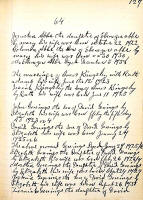
Some Ebenezer Sr. Abbey family Records.
The Massachusetts Bay
Colony (more formally The Colony of Massachusetts Bay, 1628–1691) was an
English settlement on the east coast of America in the 17th century around
the Massachusetts Bay, the northernmost of the
several colonies later reorganized as the Province of
Massachusetts Bay.
Essex County was
created by the General Court of the Massachusetts
Bay Colony on May 10, 1643, when it was ordered "that the
whole plantation within this jurisdiction be
divided into four sheires."
Named after the county
in England, Essex then comprised the towns of Salem, Lynn, Wenham, Ipswich, Rowley, Newbury, Gloucester,
and Andover.
Massachusetts Bay Colony reverted
to rule under the revoked charter until 1691, when a new charter was issued
for the Province of Massachusetts Bay. This province combined the
Massachusetts Bay territories with those of the Plymouth Colony and
proprietary holdings on Nantucket and Martha's Vineyard. Sir William
Phips arrived in 1692 bearing the charter and formally took charge of the
new province.
The Province of Massachusetts
Bay was a crown colony in British America which became one of the thirteen
original states of the United States from 1776 onward. It was chartered on
October 7, 1691 by William III and Mary II, the joint monarchs of the
kingdoms of England, Scotland, and Ireland. The charter took effect on May
14, 1692 and included the Massachusetts Bay Colony, the Plymouth Colony,
the Province of Maine, Martha's Vineyard, Nantucket, Nova Scotia, and New
Brunswick; the Commonwealth of Massachusetts is the direct successor.
Scotland, Windham Co., CT, History.
he township of Scotland, lying in the
southwestern part of the county, is about six miles long from north to south,
and about three miles wide. It lies on the southern border of the county, being
bounded on the north by Hampton and a small part of Chaplin, on the east by
Canterbury, on the south by Lisbon and Franklin, in the county of New London,
and on the west by Windham. It comprehends about eighteen square miles of
territory, much of which is hilly and in a wild condition. This is particularly
true of the northern part of the town. In the central and southern parts there
is a great deal of good farming land, and the improved farms and residences give
a very attractive and home like appearance to the country. The surface is
sufficiently rolling to make the rural landscape fascinatingly picturesque.
Merrick’s brook runs down through the middle of the town, joining the Shetucket
in the southwest corner of the town. The Providence Division of the New York &
New England railroad also runs with the Shetucket river across the southwest
corner of the town.. Here is Waldo’s station, a locality surrounded by swamps
and woods, an ancient saw mill having once been in operation near by on the
stream already mentioned. Scotland presents to the passer-by one of those
ripened communities in which the people are quietly and peacefully enjoying the
fruits of labor performed in former years, rather than living on the sweat of
present activities. The surrounding forest growth affords considerable timber,
which is utilized in railroad ties. Scotland in 1870 had a population of 648; in
1880 the population was reduced to 590. As the history of the town is but little
more than the history of the ecclesiastical society out of which it grew, we
shall address ourselves at once to the consideration of that subject.
The territory of this town was originally a part of the extensive domain of
ancient Windham, being the southeast section of that town. Settlement began
here about the year 1700. The first settler was Isaac Magoon, a Scotchman,
who gave to his adopted home the name of his native country. He was admitted
an inhabitant of Windham in 1698, and chose to establish himself east of
Merrick’s brook, in a remote and uninhabited part of the town. The brook of
which we have spoken is supposed to have been named in honor of an early
Norwich land owner. In 1700 Magoon purchased of Mr. Whiting several hundred
acres in the southern extremity of Clark & Buckingham’s tract. The first
rude hut built by him in this locality is said to have been destroyed by
fire, whereupon his Windham neighbors helped him to rebuild it. He afterward
bought sixty acres on both sides of Merrick’s brook, and crossed by the
road from Windham to Plainfield, of Joshua Ripley, and this is supposed to
have been his homestead. This road becoming a great thoroughfare between
more important points, and the good quality of the soil here, as well as the
natural beauty of location, soon attracted other settlers to the spot. In
1701 Magoon sold farms to Samuel Palmer, John Ormsbee, and Daniel and
Nathaniel Fuller, all of whom came hither from Rehoboth. In 1702 Josiah
Kingsley, John Waldo, Nathaniel Rudd, Josiah Palmer and Ralph Wheelock
purchased land of Crane and Whiting and removed to this new settlement.
Waldo’s land, in the south of this settlement, is still held by his
descendants. Many Mohegans frequented this part of the town, clinging to it
by virtue of Owaneco’s claim to it as Mamosqueage. A hut on the high hills
near Waldo’s was long the residence of the Mooch family, kindred of Uncas
and the royal line of the Mohegans. The settlement made quite rapid
progress. Among others who soon followed were Josiah Luce, Thomas Laselle,
Robert Hebard and John Burnap. Luce and Laselle were of old Huguenot stock.
Burnap came from Reading, Mass., purchasing a tract of land of Solomon Abbe,
by Merrick’s brook, April 13th, 1708.
The demand thus incited here caused valuations of real estate to rise
considerably. A saw mill was already in operation on the brook, and in 1706 a
highway was ordered to be laid out for the farmers of Scotland, above the
mill-dam, for the convenience of getting on and off the bridge which was then
about to be constructed, and thence it was to run to John Ormsbee’s land. With
the destruction of the forests and the accompanying decadence of the streams
this mill site has long since been powerless for the purposes to which it was
once appropriated. And the same may be said in regard to Wolf Pit brook, the
privilege of which was granted to Josiah Palmer in 1706, ” to set up a grist
mill-he building the same within three years and ditching and damming there as
he thinks needful on the commons, not to damnify particular men’s rights.
In 1707 the town of Windham regarded its southeastern quarter as of sufficient
importance to be allowed a burying ground, and at that time Samuel Palmer,
George Lilly and William Backus were appointed to view the ground here and
consult the people with regard to laying out a burying place in this locality.
The Scotland settlers still maintained their connection with the church at
Windham Green, though their number was constantly increasing. George Lilly, in
1710, purchased land on both sides of Little river, which runs down along the
eastern border but just outside the present limits of the town, and in 1714,
John Robinson, a descendant of Elder John Robinson, of Leyden, removed to
Scotland. The old Puritan stock was well represented in this locality.
Descendants of Robinson, Brewster and Bradford, with French Huguenots and
Scotch Presbyterians, were among its inhabitants. A pound had been erected
and a school house was built, at what date we have not learned, and about
these public institutions a straggling village grew up. Many sons of the
first settlers of Windham established themselves here. Joseph and John Cary
settled on Merrick’s brook, on land given them by their father, Deacon Cary.
Deacon Bingham’s son Samuel settled on Merrick’s brook, and Nathaniel on
Beaver brook. Nathaniel, son of Joseph Huntington, occupied a farm on
Merrick’s brook, near the center of the settlement and became one of its
most prominent citizens. The population was gathered mainly on the road to
Canterbury and on Merrick’s brook. Many of the Scotland settlers were
members of the Windham church and some were active and prominent men in the
affairs of the town.
But the Scotland settlers soon began to
feel a desire for church privileges nearer their homes than away over the hills
several miles to Windham Green. At what time this feeling began to develop into
open agitation we do not know, but it had gone so far in that direction that in
February, 1726, the town took action so far as to consent by vote that when the
public list of that section should reach in amount £12,000 the town would build
a meeting house in that section, and when they should desire to settle a
minister the town would join with them in supporting two ministers and keeping
the two meeting houses in order. In December, 1727, the Scotland people were
allowed to employ a suitable person to preach to them during the winter, and
this permission was kept up for several winters. But the Scotland people could
not see the advantage to them of paying their proportionate part of supporting
the ministry at Windham Green and then hiring a minister additional during a
part of the year, at so much extra expense. Hence the question of society
privileges was agitated, and after a spirited contest before the general
assembly the petition was granted and a charter for a distinct society was given
by the legislature in May, 1732. The bounds of the society were substantially
the bounds of the present town. They began at the junction of Merrick’s brook
with the Shetucket, thence northerly to the southwest corner of the land of John
Kingsley ; thence to Beaver brook at John Fitch’s dam ; thence a straight line
to Merrick’s brook, at the crossing of the road from Windham Green to the Burnt
Cedar swamp ; thence north on the brook to the southwest corner of Canada
Society ; thence easterly by the south bound of that society, and southerly
along the Canterbury line to the dividing line between Windham and Norwich, and
westerly along the Norwich line to the mouth of Merrick’s brook. This bound
probably included less than one-third of the territory of Windham. The
petitioners, in answer to whom the charter was granted, were Nathaniel Bingham,
Jacob Burnap, Eleazer and Samuel Palmer, Joshua Luce, Daniel Meacham, Isaac
Bingham, Samuel Hebard, Seth Palmer, Timothy Allen, Charles Mudie, Benjamin
Case, John Waldo, David Ripley, Caleb Woodward, John Cary, Jonathan Silsby,
Elisha Lilly, Jacob Lilly, Joshua Lasell, Nathaniel Huntington, Nathaniel
Brewster, Nathaniel Rudd, Wilkinson Cook, Carpenter Cook and Samuel Cook. The
number of families in the society was about eighty, and the number of persons
probably about four hundred. The list of estates reported amounted to £3,945.
The new society met to organize June 22d, 1732, at the house of Nathaniel
Huntington. Edward Waldo was chosen moderator ; John Manning, clerk ; Peter
Robinson, John Waldo and Edward Waldo, society committee_ In September the
society voted to employ a minister, and began eagerly to discuss the location of
their prospective meeting house. It was then decided that the preaching services
should be held at the house of Nathaniel Huntington. The importance of having
the business well attended to-and the magnitude of the undertaking as it
appeared to those people is shown by the vote at that time that “Ensign
Nathaniel Rudd, Mr. Samuel Manning, Lieutenant Peter Robinson, Sergeants
Nathaniel Bingham and Edward Waldo, Mr. John Bass and Mr. John Cary, be a
committee to provide us a minister to preach to us, and also to provide a place
for him to diet in, and also to agree with him for what he shall have a day.”
The minister then employed by this ponderous committee was a Mr. Flagg.
After settling some disputes as to the law in regard to electing officers, the
society unanimously set to work to locate and build a meeting house. The site
decided upon was ” a knoll, east side of Merrick’s brook, south side of the road
from Windham to Canterbury.” Nathaniel Huntington, who owned the land, promptly
made over a quarter of an acre for that purpose. June 25th, 1733, it was voted
to build a house 43 by 33 feet and twenty feet high, the roof and sides to be,
covered with chestnut sawed shingles and clapboards. The work went bravely
forward and by November 20th a society meeting was held in the house. Then the
windows were glazed, and rough board seats provided, as well as a ” conveniency
for a minister to stand by to preach.” Thus equipped the house was ready for
service and the energies of the society were then devoted to employing a regular
minister.
After several attempts, which from one cause or another proved abortive, the
society succeeded in obtaining the services of a minister to be permanently
located among them. This they found in the person of Ebenezer Devotion, son of
Reverend Ebenezer Devotion of Suffield, a young man of good abilities, pleasing
address and unimpeachable orthodoxy, who had just completed his ministerial
studies, having graduated from Yale College in 1732, and was just twenty-one
years of age when called to this parish. On the 22d of October, 1735, a church
was organized and Mr. Devotion ordained as its pastor, on a settlement of £300
and a salary of £140 a year, which was afterward increased by an additional
thirty pounds_ Eighty-nine members were dismissed from the First church of
Windham to form the Scotland church. Edward Waldo and Nathaniel Bingham were
chosen deacons.
These trying ordeals having been safely passed, the society now enjoyed a period
of peaceful and harmonious prosperity reaching through many years. The interior
of the meeting house, was subject to many changes in its arrangements and
seating, as was usual in those days, privileges being allowed individuals,
singly or in groups, to erect pews for their own use and at their own expense.
In this line one item is worthy of notice. In 1739 twelve young men had liberty
to build a pew the length of the front gallery, dividing the same by a partition
of wood, taking one half as their own seat and gallantly allowing the other half
to as many young women.
We come now to the period when this church and society were greatly agitated, in
common with others about them, by the great revival and the Separate movement,
which occurred between the years 1740 and 1750. A very respectable part of the
Scotland church became dissatisfied with the existing discipline and adopted
decided Separate principles. Mr. Devotion, who was strongly attached to church
order and the Saybrook Platform, wholly refused to grant them any concessions or
liberty, whereupon they withdrew from the . stated religious worship, and held
separate meetings in private houses. Among the number were Joseph and Hannah
Wood, Benjamin and Anne Cleveland, Zebulon and Hannah Hebard, Mrs. Samuel
Manning, John Walden, Daniel Ross, Amos Kingsley, Peleg Brewster, Thomas and
Henry Bass, and John, Sarah, Mary and Margaret Wilkinson. January 26th, 1146,
these persons were cited to appear before the church court to “give their
reasons for separating for a long time from the worship or ordinances which God
had set up among them.” Their answer in general was that the ministrations of
Mr. Devotion were not satisfying to their souls like those of other preachers,
like Lawyer Paine, Deacon Marsh and Solomon Paine, whom Mr. Devotion refused to
recognize. Nothing conciliatory resulting from the hearing and subsequent
action, these people joined themselves into a Separate church. This was
organized during the summer of 1746, and soon gained a very respectable
position, receiving into its membership some of the leading families in the
parish
The Windham County Association of ministers held an investigation in February,
1747, and after hearing much testimony in regard to the Separatists, declared
their action to be unscriptural, uncharitable and unchristian, and that the
churches ought not to recognize them in a church capacity, but to labor with
them as individuals to convert them from the error of their ways. The Scotland
Separate church was, however, notwithstanding this meeting had been held in this
town, unaffected by its judgments or proclamations, but continued to increase in
numbers and influence. One of the deacons of the standing church lapsed to the
Separatists among the rest. For a time they enjoyed the ministrations of their
favorite ministers, the Paines and Elder Marsh. John Palmer, a descendant of one
of the early Scotland settlers, exercised his gift of exhortation so freely that
he was summarily arrested by the civil authority and lodged in jail at Hartford,
where he was kept four months. This only increased his zeal, and after his
release the church gave him further trial and eventually united in a call to its
ministry. He was accordingly ordained May 17th, 1749, as pastor of the Separate
church of Scotland.
Though deficient in education and somewhat rough in speech and manner, Mr.
Palmer was a man of estimable character and sound piety, and under his guidance
the Brunswick church, as this body was now called, maintained for many years a
good standing in the community, comparatively free from those excesses and
fanaticism which marred so many of its contemporaries. No difficulty was found
in supporting its worship by voluntary – contributions. A church edifice was
built . about a mile southeast of Scotland village, and this was long known as
the Brunswick meeting house. Mr. Devotion was never reconciled to this intrusion
within his parochial limits, but true to his own name as he was to his cause, it
is said that he was accustomed every Sunday morning to send his negro servant
with a rescript to the Brunswick meeting house, forbidding Mr. Palmer or any
unauthorized person to preach therein that day ; a prohibition which doubtless
only served to increase the number of attendants there.
For many years after this Separate church was established its members were
obliged to pay their proportion of taxes for the support of the ministry in the
regular church of Scotland society. When they refused to comply with such
demands their cattle or goods were taken by distraint or themselves were
imprisoned in Windham jail. But on the prospect of having to pay rates toward
the building of the new meeting house in 1773 they petitioned the assembly for
relief, and that body gave a favorable response, granting them release from the
burden of taxation to build the house in which they did not expect, to worship.
The names of those at that time identified with the Separatist church were
Zacheus Waldo, Zebulon Hebard, Lemuel Bingham, Ebenezer Webb, John Palmer,
Benjamin Cleveland, Joseph Allen, John Walden, Stephen Webb, Israel Hale,
William Perkins, Joseph Allen, Jr., Jonathan Brewster, Ebenezer Bass, John
Silsbury, Timothy Allen, Samuel Baker, Jr., Jedidiah Bingham, Henry Bass and
Moses Cleveland.
Settling Scotland
The territory of this town was originally
a part of the extensive domain of ancient Windham, being the southeast section
of that town. Settlement began here about the year 1700. The first settler was
Isaac Magoon, a Scotchman, who gave to his adopted home the name of his native
country. He was admitted an inhabitant of Windham in 1698, and chose to
establish himself east of Merrick’s brook, in a remote and uninhabited part of
the town.
The brook of which we have spoken is
supposed to have been named in honor of an early Norwich land owner. In 1700
Magoon purchased of Mr. Whiting several hundred acres, in the southern extremity
of Clark & Buckingham’s tract. The first rude hut built by him in this locality
is said to have been destroyed by fire, whereupon his Windham neighbors helped
him to rebuild it. He afterward bought sixty acres on both sides of Merrick’s
brook, and crossed by the road from Windham to Plainfield, of Joshua Ripley, and
this is supposed to have been his homestead. This road becoming a great
thoroughfare between more important points, and the good quality of the soil
here, as well as the natural beauty of location, soon attracted other settlers
to the spot.
In 1791 Magoon sold farms to Samuel
Palmer, John Ormsbee, and Daniel and Nathaniel Fuller, all of whom came hither
from Rehoboth. In 1702. Josiah Ralph Wheelock purchased land of Crane and
Whiting and removed to this new settlement. Waldo’s land, in the south of this
settlement, is still held by his descendants. Many Mohegans frequented this part
of the town, clinging to it by virtue of Owaneco’s claim to it as Mamosqueage. A
hut on the high hills near Waldo’s was long the residence of the Mooch family,
kindred of Uncas and the royal line of the Mohegans.
The settlement made quite rapid progress.
Among others who soon followed were Josiah Luce, Thomas Laselle, Robert Hebard
and John Burnap. Luce and Lasalle were of old Huguenot stock. Burnap came from
Reading, Mass., purchasing a tract of land of Solomon Abbe, by Merrick’s brook,
April 13th, 1708. The demand thus incited here caused valuations of real estate
to rise considerably. A saw mill was already in operation on the brook, and in
1706 a highway was ordered to be laid out for the farmers of Scotland, above the
mill-damn, for the convenience of getting on and off the bridge which was then
about to be constructed, and thence it was to run to John Ormsbee’s land.
With the destruction of the forests and
the accompanying decadence of the streams this mill site has long since been
powerless for the purposes to which it was once appropriated. And the same may
be said in regard to Wolf Pit brook, the privilege of which was granted Josiah
Palmer in 1706, “to set up a grist mill—he building the same within three years
and ditching and damming there as he thinks needful to the commons, not to
damnify particular men’s rights.”
Taking Shape
In 1707 the town of Windham regarded its
southeastern quarter as of sufficient importance to be allowed a burying ground,
and at that time Samuel Palmer, George Lilly and William Backus were appointed
to view the ground here and consult the people with regard to laying out a
burying place in this locality.
The Scotland settlers still maintained
their connection with the church at Windham Green, though their number was
constantly increasing. George Lilly, in 1710, purchased land on both sides of
Little river, which runs down along the eastern border but just outside the
present limits of the town, and in 1714, John Robinson, a descendant of Elder
John Robinson, of Leyden, removed to Scotland. The old Puritan stock was well
represented in this locality. Descendants of Robinson, Brewster and Bradford,
with French Huguenots and Scotch Presbyterians, were among its inhabitants. A
pound had been erected and a school house was built, at what date we have not
learned, and about these public institutions a straggling village grew up.
Many sons of the first settlers of Windham
established themselves here. Joseph and John Cary settled on Merrick’s Brook, on
land given them by their father, Deacon Cary. Deacon Bingham’s son Samuel
settled on Merrick’s Brook, and Nathaniel on Beaver Brook. Nathaniel, son of
Joseph Huntington, occupied a farm on Merrick’s Brook, near the center of the
settlement and became one of its most prominent citizens. The population was
gathered mainly on the road to Canterbury and on Merrick’s Brook. Many of the
Scotland settlers were members of the Windham church and some were active and
prominent men in the affairs of the town.
But the Scotland settlers soon began to
feel a desire for church privileges nearer their homes than away over the hills
several miles to Windham Green. At what time this feeling began to develop into
open agitation we do not know, but it had gone so far in that direction that in
February, 1726, the town took action so far as to consent by vote that when the
public list of that section should reach in amount of 12,000 [English pounds]
the town would build a meeting house in that section, and when they should
desire to settle a minister the town would join with them in supporting two
ministers and keeping the two meeting houses in order.
In December, 1727, the Scotland people
were allowed to employ a suitable person to preach to them during the winter,
and this permission was kept up for several winters. But the Scotland people
could not see the advantage to them of paying their proportionate part of
supporting the ministry at Windham Green and then hiring a minister additional
during a part of the year, at so much extra expense. Hence the question of
society privileges was agitated, and after a spirited contest before the general
assembly the petition was granted and a charter for a distinct society was given
by the legislature in May 1732. The bounds of the society were substantially the
bounds of the present town.
They began at the junction of Merrick’s
Brook with the Shetucket, thence northerly to the southwest corner of the land
of John Kingsley; thence to Beaver brook at John Fitch’s damn; thence a straight
line to Merrick’s brook, at the crossing of the road from Windham Green to the
Burnt Cedar swamp; thence north on the brook to the southwest corner of Canada
Society; thence easterly by the south bound of that society, and southerly along
the Canterbury line to the dividing line between Windham and Norwich, and
westerly along the Norwich line to the mouth of Merrick’s brook. This bound
probably included less than one-third of the territory of Windham.
The petitioners, in answer to whom the
charter was granted, were Nathaniel Abingtham, Jacob Burnap, Eleazer and Samuel
Palmer, Joshua Luce, Daniel Meacham, Isaac Bingham, Samuel Hebard, Seth Palmer,
Timothy Allen, Charles Mudie, Benjamin Case, John Waldo, David Ripley, Caleb
Woodward, John Cary, Jonathan Silsby, Elisha Lilly, Jacob Lilly, Joshua Lasell,
Nathaniel Huntington, Nathaniel Brewster, Nathaniel Rudd, Wilkinson Cook,
Carpenter Cook and Samuel Cook. The number of families in the society was about
eighty, and the number of persons probably about four hundred. The list of
estates reported amounted to 3,945 [English pounds].
The new society met to organize June 22d,
1732, at the house of Nathaniel Huntington. Edward Waldo was chosen moderator;
John Manning, clerk; Peter Robinson, John Waldo and Edward Waldo, society
committee. In September the society voted to employ a minister, and began
eagerly to discuss the location of their prospective meeting house. It was then
decided that the preaching services should be held at the house of Nathaniel
Huntington. The importance of having the business well attended to and the
magnitude of the undertaking as it appeared to those people is shown by the vote
at that time that “Ensign Nathaniel Rudd, Mr. Samuel Manning, Lieutenant Peter
Robinson, Sergeants Nathaniel Bingham and Edward Waldo, Mr. John Bass and Mr.
John Cary, be a committee to provide us a minister to preach to us, and also to
provide a place for him to diet in, and also to agree with him for what he shall
have a day.” The minister then employed by this ponderous committee was a Mr.
Flagg.
Ebenezer Abbey Sr. was one of the settlers
who formed Canada Parish at Hampton Hill in the northeast part of Windham, and
was one of those who on May 9, 1717, signed a petition to the General Assembly
asking to be made a separate parish. In October of the same year another
petition was sent to the assembly, asking that the taxes on property in this
parish should be used for the establishing of their church. This petition was
signed by Ebenezer Abbe, for the rest," and William Durkee.
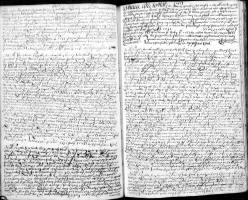
On July 9, 1731, Ebenezer Abbey Sr. gifted
100 acres of his farm near the Nauchag River to his son, Ebenezer Abbey Jr.
Signed July 9, 1731; Recorded August 17,
1731
Vol G P146-147; FHL 5908; Image 371 of 587
In this record, Ebenezer Abbe, Sr wills
how 100 acres to his son, Ebenezer Abbe, Jr near the Nauchag River and bounding
on Ginings land. Signed 9 July 1731; Recorded 17 August 1731
To all People to whome these presents shall Come Greeting know ye that I
Ebenezer Abbe of Mansfield In the County of Windham In the Colony of Connecticut
In New England for and In Consideration of the love and affection that I have
and do give to my son Ebenezer Abbe of Windham In the County aforesd I have and
by these presents do to him the Ebenezer Abbe of Windham in the County afforesd
I have and by these presents do fully freely and absolutely give grant alien
Effect & Convey pass over and Confirm to him the sd Ebenezer Abbe and to his
heirs and assigns forever a Certain tract or parcel of land containing about one
hundred acres and is part of my farm lying near Nauchaug River in Windham
afforsd and is the northerly part of my farm and is butted and bounded as
followeth viz the first bound is a white oak tree marked from thenc the Line
runs East four degrees South one hundred and Sixty rods to a small white oak
tree then the Line runs South thirty seven degrees and thirty minits West Eighty
five rods and a halfe to a heap of stones upon a rock from thence the Line Runs
westerly one hundred Rods then the line Runs Northerly seventy eight Rods to a
White oak tree then the Line Runs westerly Eighty rods bounding on Ginings land
to a white oak tree from thenc the Line runs North Eighty rods to the first
mentioned bounds.
To Have and to Hold the above granted premisses with all and singular the
appurtinances therof to the sd Ebenezer Abbe and to his heirs and assigns
forever and I the sd Ebenezer Abbe and my heirs shall and will warrant and
defend all the above granted and bargained premises to the sd Ebenezer Abbe and
to his heirs and assigns for Ever against the Lawful with Claims and demands of
all persons Claimeing the same by from or under me I Witness wherof I have
hereunto set my hand and Seal July 9 1731
Ebenezer Abbe (Seal)
Signed Sealed and dlvd In presence of us
Robert Hebard
Richard Abbe
Windham fsd July 9th 1731 the written named Ebenezer Abbe the
Subscriber to sd above or within Written Instrument personally appeared and
acknowledged sd same to be his act & deed before me
Richard Abbe, Justice of Peace
a true copie of a deed recd Augst 17 1731
test Jno Fitch Clerk
Transcribed: K. Koslan
11 July 2025
This is the transcription of the
Ebenezer Abbey Sr.
final Last Will and Testament dated June 3, 1750, in
Windham, Windham Co.,
Colony of Connecticut.
In the name of God Amen the 3d day of June anno domini 1750. I Ebenezer Abbe of
Windham in the County of Windham & Colony of Connecticut in New England being
sick & weak in body but of perfect mind & memory Thanks be given to God therefor
calling to mende the mortality of my body & knowing that it is apointed for al
men once to die do make & ordain this my Last will & Testament that is to say
prinsipaley first of all I give & recomend my Soul into the hands of God that
gave it hoping through the merits death & passion of my Lord and Saviour Jesus
Christ and to have full and free Pardon and Forgiveness of all my Sins & to
Inherit Everlasting life & my body I comit to the Earth to be decently buried at
the discretion of my excet hereafter named nothing doubting but at the general
resurrection I shall receive the same again by the Mighty Power of God – and as
touching such worldly Estate wherewith it hath pleased God to bless me in this
life I give donate & disposal of the Same in the Following manor & form viz.
I will that those debts & debters which I do owe in right or Consionce to any
manor of person or persons what socumbe will & Truly paid or ordaind to be paid
in convenient time after my decease by my Excer. hereafter named
Items I give & bequeath unto mary abbe my dearly beloved wife all my household &
Furniture & one good cow & one good horse to be All her own use & dispose
forever & also the use & improvement of one third part of all my lands the use &
improvement of the westerly end of my dwelling house & Sufficient Cellar room &
barn room During her natural life in law of dowr
Item I give & bequeath to my well beloved Son Ebenzr Abbe besides wht I have
already given him Five Shillings in bills of Credit of the old Tender or the
Equivalent thereto to be raised & Levied out of my Estate & paid in convenient
time after my decease by my Execr herein after named
Item I give & bequeath unto my well beloved son Joshua Abbe besides what I have
already given him Five shillings in bills of Credit of the old Tender or the
Equivalent thereto to be raised & Levied out of my Estate paid in convenient
time after my decease by my Execr hereafter named
Item I give & bequeath to Nathan Abbe my well beloved son besides what I have
already given him Five shillings in bills of Credit of the old Tender or the
Equivalent thereto to be raised & Levied out of my Estate paid in convenient
time after my decease by my Execr hereafter named
Item I give & bequeath unto to my well beloved son Gideon Abbe besides what I
have already given him Five shillings in bills of Credit of the old Tender or the
Equivalent thereto to be raised & Levied out of my Estate paid in convenient
time after my decease by my Execr hereafter after named
Item I give & bequeath unto my well beloved son Saml Abbe besides what I have
already given him Five shillings in bills of Credit of the old Tender or the
Equivalent thereto to be raised & Levied out of my Estate paid in convenient
time after my decease by my Execr hereafter named
Item I give & bequeath unto my well beloved daughter Elizabeth Cross besides
what I have already given her Five shillings in bills of
Credit of the old Tender or the Equivalent thereto to be raised & Levied out of my
Estate paid in convenient time after my decease by my Execr hereafter named
Item I give & bequeath unto my well beloved daughter Zerviah Marsh besides what
I have already given her Five shillings in bills of Credit of the old Tender or the
Equivalent thereto to be raised & Levied out of my Estate paid in convenient
time after my decease by my Execr herefter named
Item I give & bequeath unto my beloved daughter Jerusha Wood besides what I have
already given her Five shillings in bills of Credit of the old Tender or the
Equivalent to be raised & Levied out of my Estate & paid in convenient time
after my dcease by my Execr hereafter mentioned
Item I give & bequeath unto my beloved daughter Abigail Cary besides what I have
already given her Five shillings in bills of Credit of the old Tender or the
Equivalent thereto to be raised & Levied out of my Estate & paid in convenient
time after my decease by my Execr herein after named
Item I give & bequeath unto my beloved daughter Miriam Cross besides what I have
already given her Five shillings in bills of Credit of the old Tender or the
Equivalent thereto to be raised & Levied out of my Estate & paid in convenient
time after my decease by my Execr herein after named
Item I give & bequeath unto my well beloved grandchild Jonathan Bingham the only
surviving son & heir of my well beloved daughter Mary Bingham deceasd besides
what I gave to my daughter in her Lifetime Five Shillings in bills of Credit of
the old Tender or the equivalent thereto to be to be raised & Levied out of my
Estate after my decease by my Execr hereafter named which I will that he shall
receive when he shall attain to the age of twenty one years
Item I give & bequeath to my well beloved son Solomon Abbe to be & remain unto
him his heirs & assigns forever all my lands lying & being in the Township of
Windham & Mansfield together with all my Tenements and buildings in manor & form
following (viz) Two third parts of my sd lands The easter part of my dwelling
house & such part of the Celler room under the sd dwelling house & such part of
the room in My Barn as my sd Wife Mary shaI the sd t need during her natural
life to be by him possessed & injoyed upon my decease and the remainder in my sd
Land & building upon the Decease of my Sd wife Mary I also give unto my Sd Son
Solomon Abbe all my stock & creatures my outdoor moveables & utinsels for
farming business together with all my tools for every sort of work.
I will that all my wearing appariel be equally divided of amongst all of my
Surviving Sons. (S.S.)
Finally I will, Constitute ordain & make Col. Shubael Conant of Mansfield in the
County of Windham & Colony of Connecticut my only & Sole Exec. of this my Last
any Last Will & Testament & I do hereby of my utterly disallow revoke & disannul
all & leaving other former wills Testaments Legacies & bequests or Executors
Whatsoever by me before This Time in any who named willed or bequeathed
ratifying & confirming this and no other to be my Last Will & Testament in
confirmation whereof I the sd Ebenr Abbe have hereunto sett my hand and affixed
my Seal the day & year first First above written
Signd Seald
Publishd remanded & Declared by sd Ebenr Abbe as his Last Will and Testament in
Presence of us Witnesses
Ebener Abbe
(S.S.)
Daniel Cross
Samuel Flint
Mary Flint
Windham County fst Decr 14t 1758. Then came Mr Samuel Flint & Mrs Mary Flint
Two of the Witnesses Subscribing to the foregoing Instrument & made solemn oath
that they sd Mr. Ebenezer Abbe, the testator Deceasd sign seal & Publish the
foregoing instrument as his last Will and Testament , & that they together with
Mr Deniel Cross Sett to their hands as Witnesses in the presence of the sd
Testator & that they Judged him to be of Sound Mind & Memory according to the
best of their discerning
Sworn before me Jona Trimble Just
At a court of Probate held at Lebanon 2d January 1758. Then the foregoing will
was exhibited into sd Court by the Exectr who accepted that trust in Sd County
and Sd will is by this Sd Court proved & allowed sd & orderd to be recorded &
kept on file & Sd Execr took the oath in Sd Court according to law
Test Ichd Robinson Regr
Ebenezer Abbey
Sr. died December 5, 1758, Windham, Windham Co.,
Colony of Connecticut, at age 75.
Buried in Buried in
Windham Center Cemetery, Windham, Windham Co., CT.
Mary
(Allen) Abbey died 1766 in Windham, Windham Co., Colony of Connecticut, at about age 78.
Buried in Buried in
Windham Center Cemetery, Windham, Windham Co., CT.
From Jeromey Ward's Web Site:
Ebenezer was born in 1683, in Salem
Village, Mass., baptized in Wenham before 1685; died in Windham, Conn., December
5, 1758. He removed with his father to the locality known as "Bricktop" in 1698;
worked in Norwich for a time, about 1705; was at Windham in 1706 and later lived
at North Windham and Mansfield. November, 1705, were recorded two deeds showing
an exchange of property between Samuel Abbe and Ebenezer of Norwich, a lot upon
Bushnell's Plain. He received a deed from Samuel, July 17, 1707, and sold land
to Abraham Mitchell and William Slate in 1709 and 1711. October29, 1713, John
Abbe, now resident at Hartford, in Hartford County," sold to his brother
Ebenezer land he had received from his father, Samuel Abbe of Windham. In a deed
of November 2, 1713, he alludes to his deceased father, Samuel Abbe, January 11,
1714, land bought from his brother, Samuel Abbe, and calls Abraham Mitchell
father." He is found frequently in the records of Windham down to late in life.
September 8, 1743, he sold to his son, Samuel, land on the east side of Nauchaug
River in Windham. In 1715, Ebenezer Abbe was one of the settlers who formed
Canada Parish at Hampton Hill in the northeast part of Windham, and was one of
those who on May 9, 1717, signed a petition to the General Assembly asking to be
made a separate parish. In October of the same year another petition was sent to
the assembly, asking that the taxes on property in this parish should be used
for the establishing of their church. This petition was signed by Ebenezer Abbe,
for the rest," and William Durkee.
His will, dated June 3, 1750, probated December 14, 1758, names these heirs:
wife Mary; children Ebenezer, Joshua, Nathan, Gideon, Samuel, Elizabeth Cross,
Zeruiah Marsh, Jerusha Wood, Abigail Cary, Miriam Cross; grandson Jonathan
Bingham, only surviving son and heir of his daughter Mary, deceased. (Windham
Probate Records, Vol. 5, page 513.)
Ebenezer Abbe married at Mansfield, October 28, 1707, MARY ALLEN, who died 1766,
daughter of Joshua and Mary ( ) Allen, early settlers of Mansfield, who lived
near what is now North Windham.
Ebenezer married Mary Allen daughter of
Joshua Allen and Mary Crowell on Oct 28 1707 in Windham, Connecticut. Mary was
born on Jun 10 1688 in Windham, Connecticut. She died in 1766 in Windham,
Connecticut.